Sunday, October 31, 2010

VHDL Based Robot PART-I

AUTONOMOUS ROBOT FOLLOWING PREDEFINED
PATH USING VHDL CODING PART-I


Hello friends, we know a lot about the robot designing and programming robots using different families of microcontrollers, in this tutorial we will explore a new way of robot programming which is by VHDL coding, So let's begin….

DESCRIPTION


This article shows the application of VHDL coding in the robotic world. This autonomous robot will follow a predefined path. In our project this path is a square that is of 8 steps (each side). For this purpose we are using two power supply, one of them is used to give 5V regulated supply and other one is giving 12V unregulated dc supply. We are using CPLD kit in which VHDL coding is burned. Quartus II software is used for burning the VHDL coding in the CPLD kit. The 5V regulated dc supply is given to the CPLD kit. And 12v unregulated dc supply is used to drive the motors of the robot. The digital output from the CPLD kit is given to the Hex Inverter (Buffer) and then to the L293D driver.

BLOCK DIAGRAM


Software:- Quartus II software version 8.0 is used. This software provides the platform for writing the VHDL code.

Compilation and simulation:- After writing the VHDL code, the software provides the facility to compile and simulate the program so that an errorless program is burnt into the kit with required files.

CPLD kit:- This kit provides the facility to put the VHDL code in execution and provides required input and output.

Hex inverter:- CD4069 IC is used as hex inverter which works as a buffer as well as an inverter.

Motor driver:- L293D IC is used as motor driver. This accepts DTL and TTL logic levels and drives the load.


RESOURCES REQUIRED

COMPONENT
SPECIFICATION
QUANTITY
1.
Connectors
7     pin
2 pin
1
4
2.
Transformer
220V AC
12V/ 500 mA
Center tap.
1
3.
Diodes
1N4007
10
4.
Voltage regulator
MC7805
1
5.
Capacitors
1000Uf / 25v
10 uF/ 16v
2
1
6.
Hex inverter
CD4069
1
7.
Driver IC
L293D
1
8.
LED
Ultra red
4
9.
Resistors
1Kohm
4
10.
Connecting wires
      -
As required
11.
PCB
epoxy
1
12.
CPLD
EPM3064ALC44-10
1
13.
Soldering iron
       -
1
16.
Downloading cable
Byte blaster
1


Part-II will be focusing on the Circuit Design; Continue Reading... Cheers.

Tuesday, September 28, 2010

Fluorosint - Amazing Performance at Elevated Temperatures

Fluorosint is a high performance thermoplastic that provides extreme resistance when it is exposed or used at constant levels of high temperatures over a broad range. When it is exposed to continuous temperatures of treatment and heat it can endure heat as high as 500°F without losing its properties. Also, this polymer can resist becoming deformed as it has higher load carrying capabilities.
The main characteristics of fluorosint include:
  • Outstanding chemical and hydrolysis endurance
  • Excellent resistance to weather and UV
  • Inherent low flammability
  • Impressive maximum allowable service temperature in air up to 500°F continuously
  • High-quality electrical insulating properties
This unique thermoplastic is frequently used in a wide range of medical equipment, providing excellent services for cleaning and sterilization. Its properties offer stability, strength and stiffness and deliver outstanding mechanical performance at elevated temperatures. Though it is avidly used in numerous applications, it is often applied in dishwasher arm bearings, valve seats, labyrinth seals and shrouds, transmission and power steering seal rings, pumps, mixers, wear guides, commercial food equipment, and more.
There are different grades of fluorosint, but regardless of the grade, it’s unmatched dimensional stability and non-abrasive property is ideal for merging with most materials. It is an excellent choice for harsh conditions and challenging applications.

Saturday, September 18, 2010

Review: www.thetop10bestwebhosting.com

The Top 10 Best Web Hosting website (http://www.thetop10bestwebhosting.com/) provides an end to end review of the US and UK’s most highly rated web hosting providers. The website have a list of top 10 web hosting companies which are ranked by the web-developers and web-masters as per the quality of services provided by them. The comparison chart helps you decide to choose your own web hosting service provider as per your needs and expectations.


The in depth comparison chart on the website gives the bird’s eye view of the services offered by different web hosting providers. The list displays the comparison of different providers on following criteria -

• Price

• Disk Space Provided

• Bandwidth

• Domain Validity

• Performance stats of Uptime and Speed

• Email features and Control Panel

• Technical aspects like supported scripts

• Overall Score

• Individual Review page for each web hosting company

• Direct link to the service provider’s home page

The review link with every listed web hosting company have a detailed dedicated page containing overview of the web hosting companies with the features offered by the company and posted user reviews. The information available on web hosting UK is precise and easy to follow, the graphical view of comparison gives the clear understanding of the features of the web hosting companies and helps the visitors to pick the best one for them.

Top website provides the ranking of top web-hosting companies like JustHost, Ipage and HostClear. The detailed review on these web hosting companies are available, you can just click over and migrate to websites of these web hosting companies from the same page and extract any information about them which can range from the quality of service they provide and the cost incurred by them to the performance analysis of these web hosting provider companies, web hosting UK is a one place hub and hotspot for people looking to host their websites or those who are new in web-hosting field.

So just access the link http://www.thetop10bestwebhosting.com/ and find a lot about web hosting.

Cheers...
Aditya

Wednesday, August 25, 2010

ABOUT SOLAR POWER (Learn & Implement)

ABOUT SOLAR POWER


Hi Friends, This article is exclusively contributed for Robotics India blog by Ms. Barbara Young who is doing a great job with her personal hobby website http://www.12voltsolarpanels.net/. Her work is dedicated to helping people save energy using solar powered energy to eliminate CO2 emissions and energy dependency.

Here's a simple option to understand how solar panels work.

What's solar power?


Solar energy is radiant energy that is produced by the sun. Every day the sun radiates, or sends out, an immense amount of energy. The sun radiates more energy in a second than people have used since the beginning of time!

The energy of the Sun derives from within the sun itself. Like other stars, the sun is known as a big ball of gases––mostly hydrogen and helium atoms.

The hydrogen atoms in the sun's core combine to form helium and generate energy in a process called nuclear fusion.

During nuclear fusion, the sun's extremely high pressure and temperature cause hydrogen atoms to come apart and their nuclei (the central cores of the atoms) to fuse or combine. Four hydrogen nuclei fuse to become one helium atom. However the helium atom contains less mass compared to four hydrogen atoms that fused. Some matter is lost during nuclear fusion. The lost matter is emitted into space as radiant energy.

It takes many years for the energy in the sun's core to make its way to the solar surface, and then slightly over eight minutes to travel the 93 million miles to earth. The solar energy travels to the earth at a speed of 186,000 miles per second, the velocity of light.

Simply a small percentage of the power radiated by the sun into space strikes the earth, one part in two billion. Yet this quantity of energy is enormous. Every single day enough energy strikes the United States to provide the nation's energy needs for one and a half years!

Where does all this energy go?


About 15 percent of the sun's energy which hits the planet earth is reflected back to space. Another 30 percent is used to evaporate water, which, lifted in to the atmosphere, produces rainfall. Solar power is also absorbed by plants, the land, and the oceans. The remaining could be used to supply our energy needs.


Who invented solar technology?

People have harnessed solar technology for centuries. As early as the 7th century B.C., people used simple magnifying glasses to concentrate the light of the sun into beams so hot they would cause wood to catch fire.  Over a century ago in France, a scientist used heat from a solar collector to create steam to drive a steam engine. At first of this century, scientists and engineers began researching ways to use solar power in earnest. One important development was obviously a remarkably efficient solar boiler invented by Charles Greeley Abbott, an American astrophysicist, in 1936.

The solar hot water heater gained popularity at this time in Florida, California, and the Southwest. The industry started in the early 1920s and was in full swing just before the Second World War. This growth lasted until the mid-1950s when low-cost natural gas had become the primary fuel for heating American homes.

People and world governments remained largely indifferent to the possibilities of solar energy prior to the oil shortages of the1970s. Today, people use solar power to heat buildings and water and also to generate electricity.

How we use solar power today?

Solar energy is used in a number of different ways, of course. There are two simple forms of solar energy:

 * Solar thermal energy collects the sun's warmth through 1 of 2 means: in water or in an anti-freeze (glycol) mixture.

 * Solar photovoltaic energy converts the sun's radiation to usable electricity.

Listed here are the five most practical and popular solutions solar energy is used:


 1. Small portable solar photovoltaic systems. We see these used everywhere, from calculators to solar garden tools. Portable units can be utilized for everything from RV appliances while single panel systems can be used traffic signs and remote monitoring stations.

 2. Solar pool heating. Running water in direct circulation systems via a solar collector is a very practical method to heat water for your pool or hot spa.

 3. Thermal glycol energy to heat water. In this method (indirect circulation), glycol is heated by natural sunlight and the heat is then transferred to water in a warm water tank. This method of collecting the sun's energy is a lot more practical now than ever before. In areas as far north as Edmonton, Alberta, solar thermal to heat water is economically sound. It can pay for itself in 3 years or less.

 4. Integrating solar photovoltaic energy into your home or office power. In lots of parts of the world, solar photovoltaics is an economically feasible method to supplement the power of your own home. In Japan, photovoltaics are competitive with other forms of power. In america, new incentive programs make this form of solar power ever more viable in many states. An increasingly popular and practical way of integrating solar energy into the power of your home or business is through the use of building integrated solar photovoltaics.

 5. Large independent photovoltaic systems. When you have enough sun power at your site, you may be able to go off grid. It's also possible to integrate or hybridize your solar power system with wind power or other types of renewable power to stay 'off the grid.'

How do Photovoltaic panels work ?

Silicon is mounted beneath non-reflective glass to produce photovoltaic panels. These panels collect photons from the sun, converting them into DC electrical energy. The power created then flows into an inverter. The inverter transforms the power into basic voltage and AC electric power.
Solar cells are prepared with particular materials called semiconductors for example silicon, which is presently the most generally used. When light hits the Photovoltaic cell, a particular share of it is absorbed inside the semiconductor material. This means that the energy of the absorbed light is given to the semiconductor.


The energy unfastens the electrons, permitting them to run freely. Pv cells also have more than one electric fields that act to compel electrons unfastened by light absorption to flow in a specific direction. This flow of electrons is a current, and by introducing metal links on the top and bottom of the -Photovoltaic cell, the current can be drawn to use it externally.

What are the positives and negatives of solar energy ?

Solar Pro Arguments
  
- Heating our homes with oil or gas or using electricity from power plants running with coal and oil is a cause of climatic change and climate disruption. Solar energy, on the contrary, is clean and environmentally-friendly.

- Solar hot-water heaters require little maintenance, and their initial investment may be recovered within a relatively limited time.

- Solar hot-water heaters can work in almost any climate, even just in very cold ones. You just need to choose the right system for your climate: drainback, thermosyphon, batch-ICS, etc.

- Maintenance costs of solar powered systems are minimal and the warranties large.

- Financial incentives (USA, Canada, European states…) can help to eliminate the cost of the initial investment in solar technologies. The U.S. government, for example, offers tax credits for solar systems certified by by the SRCC (Solar Rating and Certification Corporation), which amount to 30 percent of the investment (2009-2016 period).


Solar Cons Arguments

- The first investment in Solar Hot water heaters or in Solar PV Electric Systems is greater than that required by conventional electric and gas heaters systems.

- The payback period of solar PV-electric systems is high, as well as those of solar space heating or solar cooling (only the solar hot water heating payback is short or relatively short).

- Solar water heating do not support a direct in conjunction with radiators (including baseboard ones).

- Some hvac (solar space heating and the solar cooling systems) are expensive, and rather untested technologies: solar air conditioning isn't, till now, a truly economical option.

- The efficiency of solar powered systems is rather determined by sunlight resources. It's in colder climates, where heating or electricity needs are higher, that the efficiency is smaller.


Author: Ms Barbara Young (http://www.12voltsolarpanels.net/)

Composed By: Aditya Sharma

Tuesday, August 24, 2010

DESIGNING WIRED ROBOT

ROBOZEAL WIRED ROBOT MANUAL


DESIGNING WIRED ROBOT


1. Introduction-
This is a primer project which covers following concepts-
  • Power Supply.
  • DPDT switch operation.
  • D.C. Motor.
  • Basic  motion of Robot


2. Tools & Components
There are following tools are required for this project-
  • Soldering iron
  • Hack saw/ blade
  • Screw drivers
  • Multimeter
  • Pliers
  • Wire stripper
  • Spanner
  • Hammer

There are following components are required for this project-
  • Battery (6 volt , 4.5 Ah) -             1 nos.
  • DPDT Switch-                    2nos.
  • Ribbon wire strip-                3 meters+
  • D.C. motor-                    2nos
  • Chassis(having holes for motor) -        1
  • Remote box                    1
  • Metal strip                    12
  • Wheels                        2  nos.
  • Castor wheel                    1nos
  • Soldering wire -                    as required


3. Procedure-

  1. PAPER PLANNING:

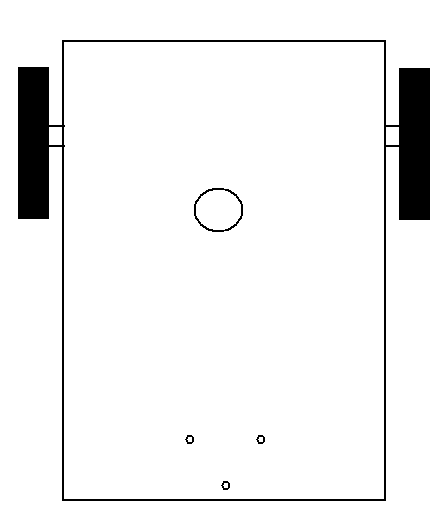
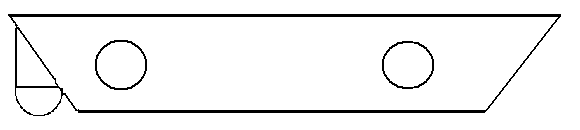
Before you start making your robot you need a paper plan. Measure length of the motor (excluding shaft), diameter of shaft of the motor, inner hole diameter of the motor. Draw a rough sketch of the base you need to cut keeping in mind the placement of motors and wheels.


Holes to fit caster wheel
Holes for wiring


TOP VIEW


Caster wheel
Holes to fit caster motor

SIDE VIEW


  1. Mechanical Assembly –  

Fit the caster wheel at position show in above diagram with 1.5-2 inches (approx.) screw. Fit the dc motor into the holes of chassis and couple the wheel by using screw or rubber tube.


Bolt is to fit outside of chassis

Coupling motors and wheels


  1. Remote Designing-

Before designing remote we have to learn basic movement of robot which is shown in following table.

Movements 

Motor1 (left)

Motor2(right)

For moving forward

Clockwise

Clockwise

For moving backward

Anticlockwise

Anticlockwise

For turning left

Off

Clockwise

For turning right

Clockwise

Off


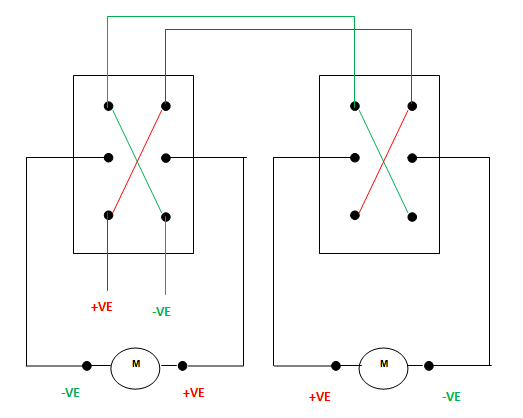
To make anti-clockwise motion of motor, the polarity of supply must be inverted of polarity of supply in clockwise motion. For "Polarity Reversal" DPDT switches are generally used. This can be done by using following circuit.


DPDT Switch Connections for REMOTE

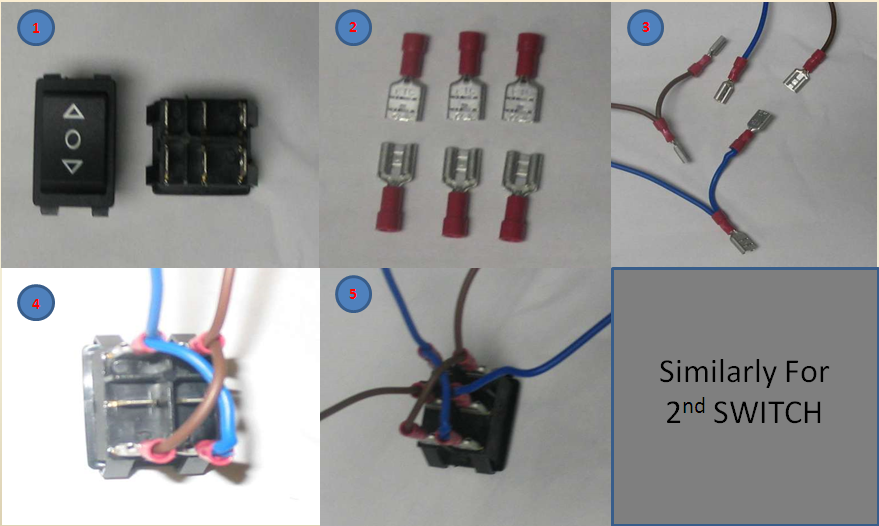
The wire should solder on metal strip not on switches directly (as shown in fig 3). This precaution helps us if there is wrong connection occurs in circuit. So we can change the circuit by changing metal strip position (fig 4). The procedure is shown in figure below-


DPDT Connections

4.  Motor connections-  

There are 4 output wires from remote which is to solder on motor by ribbon wire strip. Switch1's output should connect motor1 and switch 2's on motor2. This means switch1 controls motor 1 and switch 2 controls motor2. Before connecting motor by soldering, the polarity of motor should be check buy giving direct supplyfrom battery.


5. Power Supply-
The rechargeable battery of rating 9 Volt and 4.5 ampere rating should connected with remote switch (as shown in fig).

4. Speed calculation of robot-
Speed of robot can be calculate by following formula-
Velocity = circumference * rpm
Velocity = diameter * pi * rpm OR Velocity = 2 * radius * pi * rpm

The RPM of motor will perfect match with its specification if only is power rating of motor is provide by power supply.

Saturday, September 5, 2009

Parallel Port Monitoring Using MATLAB

MATLAB [!!Video Tutorial!!]


Hello friends , here is a small video tutorial on how to communicate to devices connected to our PCs parallel port using MATLAB programming. A large number of applications can be thought of using MATLAB as a platform in robotics. The digital bit data obtained at the parallel port can be utilized for driving DC motors or Stepper motors or other actuators.

%Code to transmit bits to the Parallel Port.
%The output1 & output2 matrix bits are transmitted sequentially.

parlport = digitalio('parallel', 'LPT1');
line = addline(parlport, 0:3, 'out');
output1 = [0 0 0 1; 0 0 1 1; 0 1 1 1; 1 1 1 1; 0 0 0 0];
output2 = [1 0 0 0; 1 1 0 0; 1 1 1 0; 1 1 1 1; 0 0 0 0];
for m=1:5
for x = 1:5
pval1 = output1(x,:);
putvalue (parlport, pval1);
pause(0.3);
end
for y = 1:5
pval2 = output2(y,:);
putvalue (parlport, pval2);
pause(0.3);
end
end

"Feel free to post your queries and doubts in the tutorial, I will try to upload some more video tutorials exploring MATLAB as a useful tool in Robotics".